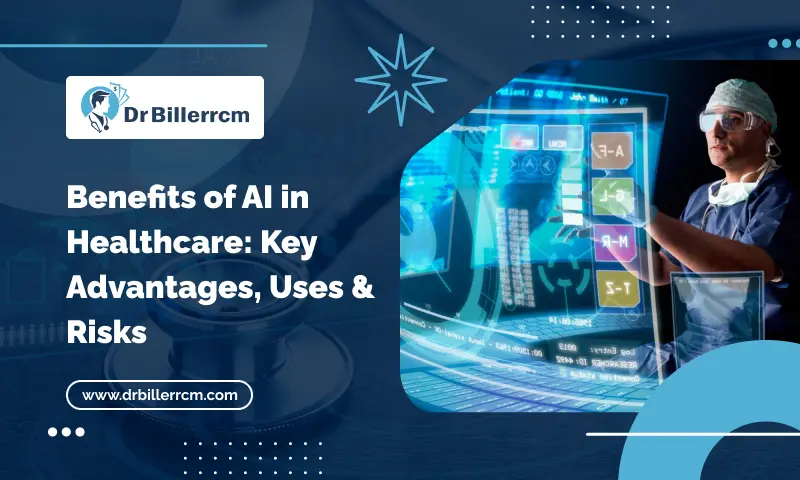
Healthcare organizations face strain because of massive documentation, huge patient data, administrative responsibilities, and demands for faster patient service. Can AI in healthcare alleviate these stresses without introducing new risks? AI is now part of standard medical practice in 2026, with 81% of physicians reporting professional use, according to the American Medical Association’s 2026 survey of 1,692 physicians.
The benefits of AI in healthcare include clinical decision support, documentation assistance, patient monitoring, data analysis, medical coding support, claims review, and revenue cycle analysis. The AMA reports that more than three-quarters of physicians surveyed in 2026 believe AI improves their ability to care for patients. AI adoption is also expanding beyond clinical care into administrative work, where reducing workload remains a major focus.
This article looks at where Artificial Intelligence in Healthcare can add demonstrable value, where risks exist, and how healthcare professionals should deploy AI with proper oversight.
What Is AI in Healthcare?
Artificial intelligence in healthcare refers to computer systems that analyze data, recognize patterns, generate information, or support decisions that traditionally require human judgment. In 2026, its use has moved beyond research: 81% of physicians surveyed by the AMA reported using AI professionally, compared with 38% in 2023.
How Artificial Intelligence Works in Healthcare
AI uses technologies such as machine learning, natural language processing, generative AI, and predictive analytics to process clinical and administrative information. Common applications include:
- Reviewing medical images and identifying patterns
- Summarizing clinical records and research
- Supporting documentation and care plans
- Assisting medical coding and billing workflows
- Identifying patient risks and trends
- Analyzing claims and revenue-cycle data
- Supporting patient communication
Why Healthcare Organizations Are Adopting AI
AI adoption is increasing because healthcare teams must manage large amounts of information while controlling administrative workload and maintaining quality. More than three-quarters of physicians surveyed by the AMA said AI improves their ability to care for patients.
AI-enabled medical technology is also expanding. The FDA keeps a growing list of certified AI-enabled medical devices and updates it as new devices are approved.
Still, adoption should involve human review, data protection, performance testing, and clear accountability. AI can support a physician, coder, biller, or administrator, but its output should not replace professional judgment.
10 Key Benefits of AI in Healthcare
AI is increasingly being used across clinical, administrative, and financial healthcare workflows. The value varies by use case, but current adoption shows that healthcare professionals are already using AI for practical tasks rather than treating it as a future concept.
1. Supports Earlier Disease Detection
AI can review medical images, clinical records, and other health data to identify patterns that may require professional attention. The FDA’s 2026 authorized-device list includes AI-enabled tools for areas such as radiology, cardiovascular care, neurology, gastroenterology, and dentistry.
2. Improves Clinical Decision Support
AI can organize patient information, identify risk patterns, and provide decision-support information. It should support, rather than replace, clinical judgment. In 2026, more than three-quarters of physicians surveyed by the AMA said AI improves their ability to care for patients.
3. Reduces Administrative Workload
AI can assist with documentation, research summaries, care plans, scheduling, and routine information processing. The AMA reports that 30% of surveyed physicians use AI to create discharge instructions, care plans, or progress notes.
4. Supports More Accurate Medical Documentation
AI can summarize records, organize clinical information, and assist with visit documentation. In the AMA’s 2026 survey, 28% of physicians reported using AI for billing-code, medical-chart, or visit-note documentation.
5. Improves Medical Coding and Billing Workflows
AI can flag potential documentation gaps, suggest coding information, and identify inconsistencies for professional review. ICD-10-CM, CPT®, and HCPCS selections still require qualified validation and payer-specific review.
6. Supports Revenue Cycle Management
AI can examine claims, identify recurring denial patterns, prioritize accounts, and analyze payment data. These functions can help RCM teams focus attention where manual review is most useful.
7. Improves Patient Engagement and Access
AI can support appointment communication, routine questions, patient education, and remote-care interactions. Human involvement remains important for clinical questions and sensitive patient situations.
8. Supports Predictive Analytics and Patient Monitoring
AI can evaluate large datasets to identify risk patterns and support monitoring. FDA-authorized AI-enabled devices in 2026 include technologies for cardiovascular and neurological applications.
9. Helps Healthcare Organizations Analyze Data
AI can process large amounts of clinical, operational, and financial information faster than manual review. Healthcare leaders can use these analyses to identify trends, workload issues, and areas requiring further investigation.
10. Supports Healthcare Research and Drug Development
AI can assist researchers with data analysis, study design, medical literature review, and other research tasks. Its usefulness still depends on data quality, validation, appropriate oversight, and the intended use of the system.
How AI Improves the Patient Experience
AI can help patients receive information, reminders, and routine support with less delay. Its value is strongest when it supports healthcare staff while keeping clinical decisions and sensitive interactions under professional oversight.
Faster Patient Communication
AI-powered systems can assist with appointment reminders, common questions, follow-up messages, and basic patient instructions. This can reduce response delays and help staff manage routine communication more efficiently.
For example, AI can help patients:
- Confirm or reschedule appointments
- Receive medication or follow-up reminders
- Find basic information about services
- Receive updates about routine administrative requests
- Access health information in a more accessible format
Personalized Patient Support
AI can analyze approved patient information to provide relevant educational material, reminders, or follow-up prompts. For patients managing ongoing conditions, these tools may support regular communication and help care teams identify information that needs attention.
AI-generated information should still be reviewed when it involves clinical guidance. Patients should have access to qualified healthcare professionals for diagnosis, treatment decisions, or urgent concerns.
Remote Patient Monitoring
AI can analyze information from remote monitoring devices and identify patterns that may warrant clinical review. This can support care for patients with chronic conditions and help healthcare teams focus on readings or changes that require attention.
Does AI Replace Healthcare Professionals?
AI can assist with data analysis, documentation, communication, and repetitive tasks, but it does not remove the need for qualified healthcare professionals. Safe use depends on human review, clinical judgment, professional accountability, and appropriate oversight.
AI as a Support Tool
AI can help physicians, nurses, medical coders, billers, HIM professionals, and administrators process information and identify items that need attention. For example, an AI system may suggest a code, summarize a patient record, flag a potential claim issue, or identify a clinical risk pattern.
These outputs are recommendations, not final decisions. Professionals must verify information against the patient’s documentation, current guidelines, payer requirements, and applicable regulations.
Why Human Expertise Still Matters
Healthcare decisions often require context that an AI system may not fully understand. Physicians assess symptoms and patient history, while coders interpret documentation and apply coding rules. Compliance professionals evaluate regulatory requirements, and billing teams review payer-specific issues.
Human oversight remains important for:
- Clinical diagnosis and treatment decisions
- ICD-10-CM, CPT, and HCPCS code validation
- Medical necessity assessment
- Claims and denial review
- Privacy and compliance decisions
- Patient communication involving sensitive concerns
- Ethical and professional judgment
Conclusion
The benefits of AI in healthcare extend from clinical decision support and patient monitoring to documentation, medical coding, billing, and revenue cycle management. Its value depends on accurate data, appropriate use, and measurable outcomes.
AI should support healthcare professionals rather than replace their judgment. With proper oversight, privacy controls, validation, and compliance practices, healthcare organizations can use AI to improve efficiency while protecting patient care and professional accountability.
FAQs
What are the main benefits of AI in healthcare?
The benefits of AI in healthcare include clinical decision support, earlier risk detection, documentation assistance, patient monitoring, data analysis, and administrative support. AI can also assist medical billing, coding, claims review, and revenue cycle processes.
How can AI improve medical billing and coding?
AI can review documentation, identify potential coding issues, flag claim errors, categorize denials, and analyze payment patterns. Certified coders and billing professionals should verify AI recommendations against current coding guidelines and payer requirements.
Can AI replace physicians, medical coders, or billers?
AI is primarily a support tool and does not replace professional judgment. Physicians, coders, billers, and compliance professionals remain responsible for decisions involving patient care, coding accuracy, claims, and regulatory requirements.
What are the risks of using AI in healthcare?
Key risks include inaccurate outputs, data privacy concerns, cybersecurity threats, algorithmic bias, insufficient validation, and unclear accountability. Healthcare organizations should establish appropriate review procedures before using AI for important decisions.
How can healthcare organizations use AI responsibly?
Organizations should identify a specific use case, assess data quality and security, test AI performance, establish human oversight, and monitor results after implementation. AI use should also follow applicable privacy, coding, billing, and healthcare regulations.