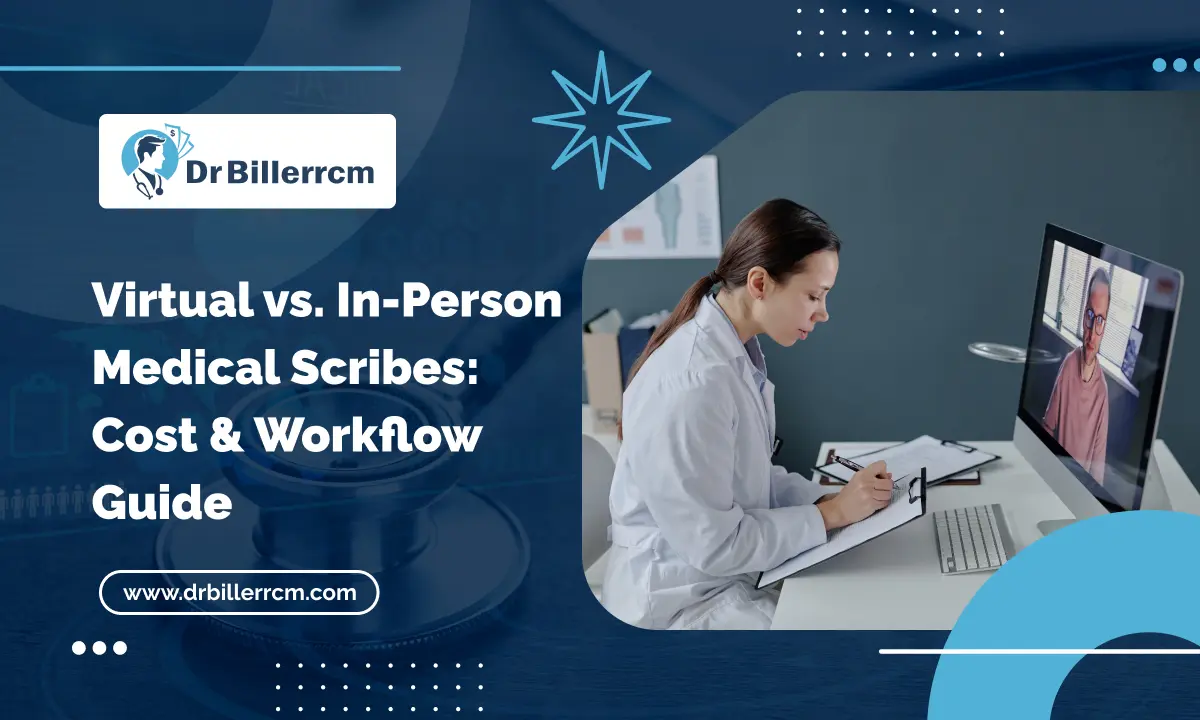
Why choose a virtual scribe when an in-person medical scribe can work beside the provider? The wrong choice can increase documentation delays, staffing costs, EHR workload, and communication gaps. When comparing virtual and in-person medical scribes, healthcare providers can choose the approach that is appropriate to their daily tasks.
Virtual medical scribe services can reduce the need for physical space while providing flexible coverage. However, they rely on secure technology, consistent connectivity, and clear communication. In-person medical scribes provide direct support during patient visits; however, they might face recruitment, benefits, workspace, and replacement costs. AAFP-cited research found that medical scribes increased patient face time by 57% while decreasing EHR time by 27%, but these results may not apply to all practices.
This guide compares both options across EHR integration, medical documentation support, coding and billing needs, security, staffing, scalability, and total cost. It also explains where each model may work well and what practices should check before making a decision.
What Is a Medical Scribe?
A medical scribe supports clinicians by documenting patient encounters and completing permitted EHR documentation tasks under clinical direction. The duty can be performed in the testing room or remotely, so the work model is as important as the job title.
A medical scribe can record the history, examination results, assessment, plan, and other encounter details in the EHR. Depending on the practice and job description, the role may also include retrieving clinical information or preparing documentation for provider review.
Complete clinical documentation can also support downstream medical coding services because coders rely on appropriate clinical information when reviewing encounters and assigning codes.
The Joint Commission’s modified guidance, on April 23, 2026, indicates that documentation assistants can be unlicensed, certified, or licensed, as long as their work fulfills their established responsibilities and scope.
Why Does the Scribe Model Matter?
The difference between virtual medical scribe services and in-person medical scribes affects cost, communication, EHR access, staffing, and patient interaction.
AAFP’s current reference data lists monthly costs of $2,500–$4,500 for medical scribes and $1,000–$1,200 for virtual scribes. AAFP also reports a 57% increase in patient face time and a 27% decrease in EHR time in research involving medical scribes. These figures are reference points, not guaranteed results for every practice.
For physicians, billers, coders, and practice managers, the key question is therefore broader than price: Which scribe model fits the practice’s documentation workflow, EHR setup, staffing needs, and patient-care environment?
For smaller organizations, this decision can also be considered alongside the broader requirements addressed by medical billing services for small practices.
Virtual vs. In-Person Medical Scribes: Key Differences
The choice affects more than where the scribe sits. Cost, EHR access, patient interaction, privacy, and specialty workflow can change how well each model fits a practice.
Location and Communication
In-person medical scribes work beside the provider, usually in the exam room. This allows direct conversation and immediate clarification during the encounter. This model can also be used in situations where the scribe needs to observe the visit directly.
Virtual medical scribe services connect remotely through approved communication technology. Depending on the service, this may involve secure audio, video, or other remote documentation methods. A virtual model can reduce the need for workspace and may give practices access to a larger staffing pool.
EHR Access and Documentation Workflow
Both models depend on clear EHR permissions and defined documentation responsibilities. In-person scribes can document directly during visits, while virtual workflows depend on secure remote access and reliable connectivity.
Practices should verify user permissions, authentication, note templates, turnaround times, and provider review. The Joint Commission identifies EMR functionality, HIPAA, and billing and coding principles among scribe competencies.
For practices using electronic health records, documentation workflows should also be considered alongside their broader EHR/EMR billing services requirements.
Patient Experience and Privacy
An in-person scribe adds another person to the clinical encounter. Some patients may accept this easily, while others may prefer fewer people in the room.
A virtual scribe reduces the third party but adds technology and remote PHI access. Patient communication, consent practices, access controls, and vendor safety procedures need to be evaluated before implementation.
Specialty and Clinical Workflow
The best fit can vary by specialty. A high-volume primary care clinic may value flexible remote documentation, while a procedure-heavy setting may place greater value on immediate onsite interaction.
A useful medical scribe comparison should therefore consider patient volume, visit type, EHR setup, documentation timing, staffing coverage, and clinical environment, not cost alone.
Cost and Overhead Comparison
The listed service rate is only one part of the expense. A fair comparison should include payroll, benefits, workspace, training, technology, coverage, and the time required to manage each model.
Hidden Costs of In-Person Medical Scribes
An in-person scribe can involve expenses beyond wages. Depending on the employment arrangement, practices may need to account for:
- Payroll taxes and employee benefits
- Recruitment, onboarding, and training
- Workspace, equipment, and supplies
- Paid time off and sick-day coverage
- Turnover and replacement training
- Supervisory and scheduling time
AAFP currently lists $2,500–$4,500 per month as a reference cost for medical scribes. It also notes that in-person scribes can reduce physician documentation work and increase patient face time.
Costs Associated With Virtual Medical Scribe Services
Virtual medical scribe services generally shift more of the staffing expense to a service arrangement. AAFP lists $1,000–$1,200 per month for virtual scribes. However, practices should check what the quoted rate actually includes.
Review:
- Hourly or monthly service limits
- EHR access and setup
- Equipment or audio requirements
- Training and implementation
- After-hours coverage
- Backup staffing
- Note turnaround expectations
A lower monthly rate may still create added costs if the practice must supply technology or manage coverage separately.
What Is the Total Cost of Ownership?
The better calculation is total cost ÷ useful documentation capacity, rather than comparing advertised rates alone. Include direct fees, staff management, technology, training, coverage, and physician time spent correcting or reviewing notes.
For a multi-provider practice, consider how easily days could be increased or reduced. This makes cost and staffing flexibility important parts of the medical scribe comparison, rather than treating price as the only deciding factor.
The American Academy of Family Physicians (AAFP) provides the following reference figures. Actual pricing varies by specialty, location, schedule, and service arrangement.
| Cost Factor | In-Person Medical Scribes | ScribesVirtual Medical Scribe Services |
| Monthly reference cost | $2,500–$4,500 | $1,000–$1,200 |
| Employment expenses | Payroll taxes, benefits, paid leave | Usually included in vendor pricing; verify contract terms |
| Workspace | Requires onsite space and equipment | May require secure devices, headsets, and connectivity |
| Training | Practice manages onboarding and ongoing training | Vendor may provide training; responsibilities vary |
| Scheduling | Limited by local staff availability | May offer flexible hours, depending on the agreement |
How Virtual and In-Person Scribes Fit Into the EHR Workflow
The scribe model affects how information reaches the medical record, how quickly notes are prepared, and how providers review them. EHR access should be based on individual credentials, defined permissions, and documented responsibilities.
How Virtual Scribes Connect With EHR/EMR Systems
Virtual medical scribe services may use secure audio, video, remote EHR access, or other approved communication methods. The exact setup depends on the vendor and EHR. A practice should verify encryption, authentication, user permissions, access logs, and PHI handling before ensuring remote access.
The Joint Commission’s guidance, updated April 23, 2026, identifies independent EMR logins, defined documentation duties, training, and provider review as important safeguards. It also states that contracted documentation services should meet the same competency and quality expectations as internally provided services.
How In-Person Scribes Work Inside the Practice
An in-person scribe can document directly during the patient encounter and respond immediately when the provider needs clarification. This can be useful for high-volume clinics or workflows that depend on continuous face-to-face communication.
AAFP reports that medical scribes can increase patient face time by 57% and reduce EHR time by 27% in the cited research.
What Happens When the EHR or Connection Fails?
Every model needs a downtime plan. Internet, audio, authentication, and remote access issues all have an impact on virtual operations. In-person teams may still rely on the EHR, network connection, and workstation availability. In-person teams may still rely on the EHR, network connection, and workstation availability.
A practical backup plan should define:
- Temporary documentation procedures
- Downtime access and recovery steps
- Who enters delayed information
- Provider review and authentication
- How technical incidents are reported
HIPAA, Privacy, and Security Considerations
A virtual scribe introduces remote access to clinical information, while an in-person scribe has physical access to the patient encounter and practice environment. Both models require clear privacy controls, defined responsibilities, and appropriate staff training.
Questions to Ask a Virtual Scribe Provider
Before allowing remote virtual medical scribe services to access an EHR, practices should ask:
- Is the service covered by a written Business Associate Agreement when required?
- How are PHI, audio, video, and notes protected during transmission and storage?
- Does each scribe use an individual EHR login rather than a provider’s credentials?
- What access permissions are granted, and how are they removed when staffing changes?
- Are access logs reviewed for inappropriate activity?
- What happens to recordings or temporary files after documentation is completed?
- What procedures apply during a security incident or service outage?
The Joint Commission’s guidance, updated April 23, 2026, specifically identifies independent EMR logins, defined documentation duties, HIPAA training, and provider review as important safeguards.
Privacy Considerations for In-Person Scribes
An in-person scribe also has access to protected health information. The practice should control access to exam rooms, workstations, printed records, and other patient information.
Patients should also understand the scribe’s role when appropriate. Staff training should cover confidentiality, HIPAA requirements, EHR use, and the limits of the scribe’s duties.
Key point: Calling a service “virtual” or “HIPAA compliant” does not, by itself, establish that the entire workflow meets applicable privacy and security requirements. Practices should assess the actual technology, contracts, permissions, training, and oversight before implementation.
Scalability, Scheduling, and Staff Turnover
Scribe coverage needs can change with patient volume, provider schedules, new locations, and seasonal demand. A useful medical scribe comparison should therefore examine how easily each model adjusts when staffing needs change.
Scaling Virtual Scribe Hours
Virtual medical scribe services can give practices more scheduling flexibility. Depending on the vendor agreement, a practice may be able to increase coverage during high-volume periods or reduce hours when demand falls.
This can be useful for:
- New providers building their patient panels
- Telehealth and extended-hour clinics
- Multi-location practices
- Temporary increases in appointment volume
- Providers who need part-time documentation support
In-Person Staffing and Turnover
In-person medical scribes require local recruitment, onboarding, scheduling, workspace, and ongoing supervision. A staff departure can leave a provider without documentation support until another person is hired and trained.
Turnover can also affect documentation consistency because each new scribe must learn the practice’s EHR workflow, specialty terminology, documentation standards, and provider preferences.
How Agency-Based Virtual Services Handle Coverage
An agency may maintain a larger scribe pool, allowing another trained scribe to cover absences or staff turnover. However, coverage policies vary by provider and contract.
Before choosing a service, ask:
1. Is replacement coverage included?
2. How quickly can a substitute be assigned?
3. Is specialty-specific experience required?
4. Who manages training and performance review?
5. Can hours be increased or reduced?
Conclusion
Choosing between virtual and in-person medical scribes requires a review of documentation needs, EHR workflow, staffing costs, privacy controls, and patient interaction.
Virtual medical scribe services can allow flexible scheduling and remote coverage, but in-person medical scribes provide direct on-site help. Each model has practical pros and cons.
The right choice depends on your practice’s specialty, budget, patient volume, and operational needs. Compare total costs, service reliability, provider oversight, and backup coverage before making a decision.
FAQs
What is the difference between virtual and in-person medical scribes?
Virtual medical scribes provide documentation support remotely through approved technology, while in-person medical scribes work onsite with the provider. Both can document encounters under defined provider oversight.
Are virtual medical scribe services less expensive than in-person scribes?
They can have lower direct costs because practices may avoid some workspace, recruitment, and employee expenses. Actual costs depend on service rates, hours, technology, training, and coverage requirements.
Can a virtual medical scribe access the practice’s EHR?
Yes, if the practice’s EHR and security policies permit remote access. Each scribe should have appropriate permissions and an individual login, with defined documentation duties and provider review.
Which medical scribe model offers more scheduling flexibility?
Virtual medical scribe services may provide greater scheduling flexibility because coverage can be adjusted remotely. Availability, minimum hours, and backup coverage depend on the service agreement.
How should a practice choose between virtual and in-person medical scribes?
Compare total cost, EHR workflow, patient interaction, privacy controls, documentation timing, specialty needs, staffing, and backup coverage. The choice should match the practice’s operational requirements.