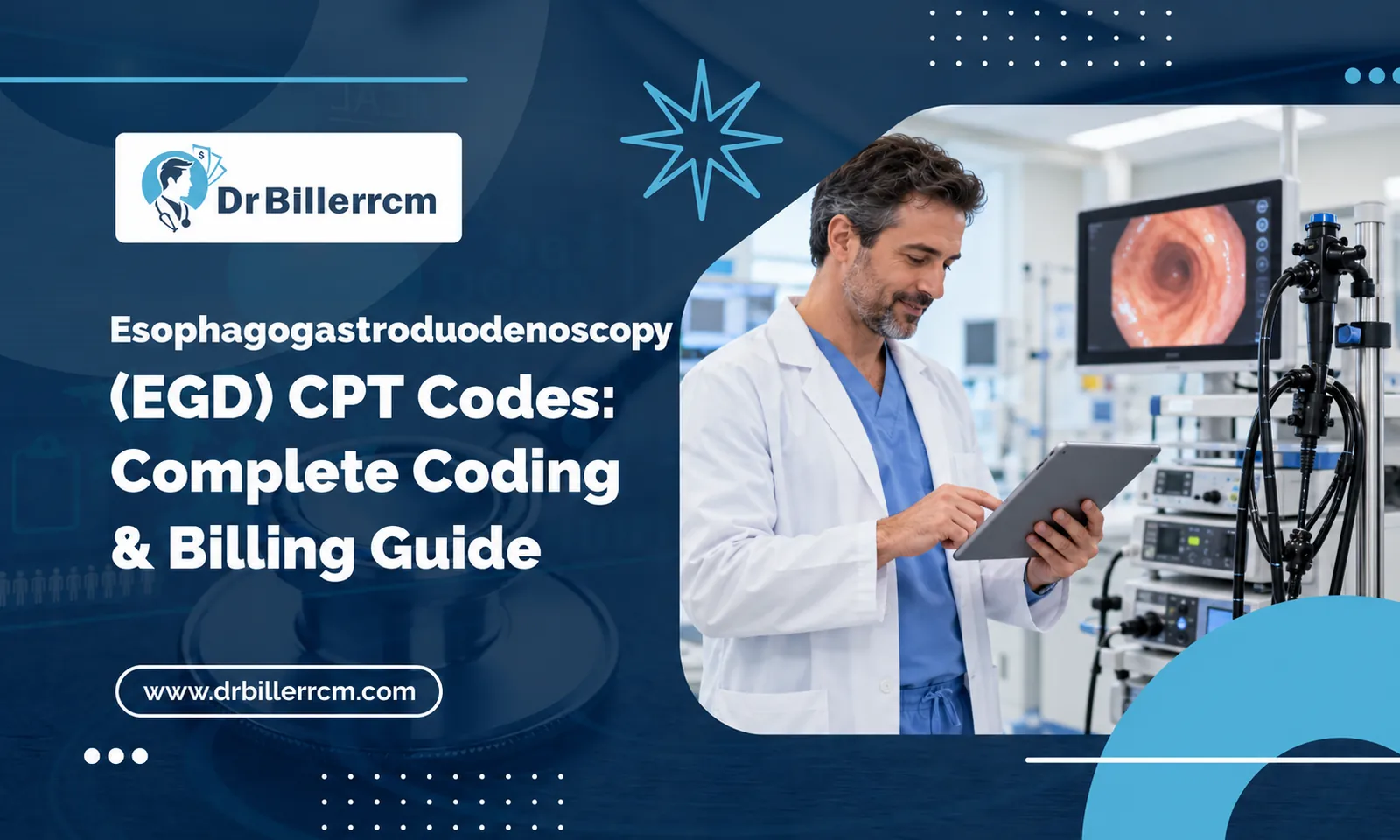
Esophagogastroduodenoscopy (EGD) CPT codes describe flexible scopes passed through the mouth into the esophagus, stomach and duodenum. The core codes run from 43233 to 43259, plus 43266 for stents and 43270 for ablation. Code 43235 is the diagnostic base. So, you report each distinct technique once, and Medicare pays each extra EGD code only at its value above 43235.
Key takeaways
- 43235: the diagnostic base code. Never bill it with a therapeutic EGD code.
- 43239: one unit covers one biopsy or many.
- Dilation: 43248 for wire-guided dilators, 43249 for balloons under 30 mm, 43233 for balloons of 30 mm or more, and 43245 for the stomach or duodenum.
- Bleeding: bleeding the EGD itself causes is not 43255.
- Payment: Medicare uses a special endoscopy rule for physicians, while ASCs follow a 50% multiple procedure discount when it applies.
Esophagogastroduodenoscopy (EGD) CPT Codes: The 2026 List
All EGD CPT codes build on 43235, the diagnostic exam. Every other code in the family already includes that look. As a result, the base code drops off as soon as you report a therapeutic service.
For 2026, the ASGE 2026 EGD coding sheet found no new, deleted or revised EGD codes. Codes 43256 and 43258 stay deleted, so use 43266 for stents and 43270 for ablation instead. The CMS 2026 fee schedule file also names 43235 as the endoscopic base for every code below.
Diagnostic, Biopsy and Lesion Removal Codes
| CPT code | What it covers (plain-language summary) |
|---|---|
| 43235 | Diagnostic EGD; brushings or washings included |
| 43236 | Directed submucosal injection of any substance |
| 43239 | Biopsy, single or multiple |
| 43250 | Lesion or polyp removal with hot biopsy forceps |
| 43251 | Lesion or polyp removal with a snare |
| 43252 | Optical endomicroscopy |
| 43254 | Endoscopic mucosal resection (EMR) |
| 43270 | Ablation of lesions; covers dilation and guide wire use |
Dilation, Stent, Tube and Bleeding Codes
| CPT code | What it covers (plain-language summary) |
|---|---|
| 43233 | Esophageal balloon dilation, 30 mm or larger; covers fluoroscopy |
| 43241 | Insertion of a tube or catheter into the GI tract |
| 43243 | Sclerotherapy injection of varices |
| 43244 | Band ligation of varices |
| 43245 | Dilation of stomach or duodenal strictures, balloon or bougie |
| 43246 | Directed PEG tube placement |
| 43247 | Foreign body removal |
| 43248 | Guide wire placement, then dilators passed over it |
| 43249 | Esophageal balloon dilation under 30 mm |
| 43255 | Control of bleeding, any method |
| 43257 | Thermal energy to the lower esophageal sphincter for GERD |
| 43266 | Stent placement; covers dilation and guide wire use |
Not EGD codes. Most codes from 43191 to 43232 describe esophagoscopy, which stops at the esophagus. Codes 43260 to 43278 describe ERCP. Also, the EGD family includes 43210 (transoral fundoplasty) and 43290 and 43291 (gastric balloon placement and removal).
EGD With Biopsy CPT Code: 43239
CPT 43239 covers forceps biopsy, whether the doctor takes one sample or twenty. Therefore, bill one unit, even when samples come from the esophagus, stomach and duodenum. NCCI says a code that uses the plural word for biopsies takes one unit of service.
Brushings and washings do not count as a biopsy, though. They stay inside 43235. Meanwhile, the pathology lab bills its own service for each specimen, which our CPT 88305 guide explains.
EGD With Polypectomy and Biopsy in One Session
- Same lesion: if the doctor biopsies a polyp and then removes it, report only the removal code, such as 43251.
- Different lesions: report both codes. When an NCCI edit pairs them, add modifier XS or 59 to the code the edit bundles.
- Same technique on several lesions: report that code once for the region, per NCCI.
- Different removal tools: hot forceps (43250), snare (43251) and EMR (43254) are separate codes, so document which tool removed which lesion.
EGD With Dilation CPT Codes
The dilation tool, not the diagnosis, decides the code. For example, a balloon under 30 mm and a wire-guided dilator lead to different codes, even for the same stricture.
| Technique documented | CPT code |
|---|---|
| Guide wire placed, then dilators passed over the wire | 43248 |
| Balloon through the scope, under 30 mm | 43249 |
| Balloon of 30 mm or larger, often for achalasia | 43233 |
| Stricture in the stomach or duodenum, balloon or bougie | 43245 |
| Unguided bougie, such as a Maloney, without a scope | 43450 |
| Dilator over a guide wire, without a scope | 43453 |
EGD With Maloney Dilation CPT Code
Maloney dilators are weighted bougies that the doctor passes without a guide wire. So they fit 43450, not 43248. Some online summaries list Maloney under 43248, which mixes up the two techniques.
If a non-endoscopic dilation fails and the doctor then dilates through the scope, NCCI lets you report only the endoscopic dilation. When an EGD and a separate Maloney pass both happen, check the current NCCI edit for that pair before you bill both.
Finally, link the dilation to the documented cause. For instance, K22.2 covers esophageal obstruction, and K22.0 covers achalasia. When the record shows only symptoms, our dysphagia ICD-10 guide covers the R13.1- codes.
EGD With Stent Removal, Foreign Body and PEG Codes
EGD With Stent Removal CPT Code
No CPT code names upper GI stent removal. Instead, NCCI Chapter VI lets you report a code such as 43247, the foreign body code, when a previously placed device can only come out through the scope. However, it does not apply when the doctor removes the device without endoscopy. So, confirm the approach with your payer when the stent removal is the only service.
New stent placement uses 43266, which already includes dilation and guide wire passage. If the doctor removes one stent and places another in the same session, check the NCCI edit for 43247 with 43266 first. Biliary stents differ, since they belong to ERCP codes 43275 and 43276.
CPT Code for EGD With Foreign Body Removal
Code 43247 covers food boluses, coins and other objects, whatever tool the doctor uses. Also, NCCI bundles any fluoroscopy used during the removal into the endoscopy.
CPT Code for EGD With PEG Tube Placement
Code 43246 covers directed PEG tube placement. Later, a tube change without imaging or a scope uses 43762, or 43763 when the tract needs revision. In addition, NCCI bundles a later removal without endoscopy into the original placement.
Bleeding Control, Clips, Banding and Botox Injection
EGD With Control of Bleeding and Clip Placement
Code 43255 covers bleeding control by any method, such as clips, heat or injection. Still, NCCI treats bleeding control as part of every endoscopy. So, when the doctor clips a site that bled because of a polypectomy in the same session, report only the polypectomy.
Use 43255 when the EGD treats bleeding that existed before the scope went in, such as a bleeding ulcer. A preventive clip after a polypectomy is not 43255 either. However, if the patient returns the same day for a second EGD to stop new bleeding, NCCI allows the repeat procedure with modifier 78.
Some AI answers tell coders to add 43255 when a clip stops bleeding at a polypectomy site. NCCI Chapter VI says control of bleeding is integral to the endoscopy, so that pairing invites a denial or a refund request.
EGD With Banding CPT Code
Band ligation of esophageal or gastric varices uses 43244. In contrast, injection sclerotherapy of varices uses 43243. Avoid 43255 for variceal treatment, because these specific codes exist.
EGD With Botox Injection CPT Code
Botulinum toxin injected into the lower esophageal sphincter, often for achalasia, uses 43236. That code covers submucosal injection of any substance. Then bill the drug on its own line, such as J0585 per unit for onabotulinumtoxinA. Also, follow Medicare rules for the JW or JZ modifier on single-dose vials.
EGD With EUS CPT Codes
Endoscopic ultrasound (EUS) codes depend on how far the exam goes. They also depend on whether the doctor samples tissue or injects a substance. So, confirm the exam extent in the report before you choose.
| CPT code | What it covers (plain-language summary) |
|---|---|
| 43237 | EUS limited to the esophagus, stomach or duodenum, plus nearby structures |
| 43259 | EUS of the esophagus, stomach and duodenum, or the jejunum past a surgical connection |
| 43238 | EUS-guided needle aspiration or biopsy with the limited exam |
| 43242 | Needle aspiration or biopsy under EUS, with the full exam |
| 43253 | Injection through the wall under EUS, or fiducial marker placement |
| 43240 | Drainage of a pseudocyst through the wall, with stents and EUS when done |
No EGD code names the liver. Therefore, for an EUS-guided liver biopsy, check the current CPT descriptors and your payer before you choose 43238 or 43242.
How Medicare Pays Multiple EGD Codes
Medicare does not simply cut each extra EGD code by 50% on the physician claim. Instead, Chapter 12, section 40.6 of the Medicare Claims Processing Manual applies a special endoscopy rule to codes in the same family. Medicare pays the highest-valued code in full. Then it adds only the difference between each extra code and the base code, 43235.
Worked Example: Biopsy Plus Balloon Dilation
Here is a hypothetical facility-setting claim. It uses 2026 national amounts from the October 2026 CMS fee schedule file (RVU26D), with the standard conversion factor of 33.4009 and no locality adjustment.
| Line | Facility RVUs | National amount | Medicare allows |
|---|---|---|---|
| 43249 balloon dilation | 4.08 | $136.28 | $136.28 (full) |
| 43239 biopsy | 3.70 | $123.58 | $13.02 (43239 minus 43235) |
| 43235 base (not billed) | 3.31 | $110.56 | Used only for the math |
| Total | $149.30 |
A standard 50% cut would have allowed $198.07. As a result, expect the lower figure on the remittance. Your real payment also reflects your locality, coinsurance and sequestration. Meanwhile, unrelated families on the same day, such as an EGD and a colonoscopy, follow the usual multiple surgery rules.
NCCI Edits and Modifiers for EGD Claims
The CMS NCCI Policy Manual, Chapter VI, sets the main bundling rules for upper GI endoscopy. Apply these before you add any modifier.
- Surgical endoscopy includes diagnostic endoscopy, so never pair 43235 with a therapeutic EGD code.
- Code 43235 carries separate procedure status. Thus, it drops when another procedure in the same session uses the same orifice.
- Report the most complete code first. Then add codes only when one code cannot describe the work.
- The same procedure repeated in one region counts once.
- NCCI bundles fluoroscopy into the endoscopy, so do not bill it on top.
Which Modifiers Apply to EGD?
| Modifier | When it fits |
|---|---|
| XS or 59 | Distinct lesion or site when an NCCI edit pairs the codes; prefer XS when it fits |
| XE | Separate encounter on the same date |
| 53 | Physician stops the EGD because of risk to the patient |
| 52 | Reduced service on the physician claim; check payer rules |
| 73 | ASC stops before anesthesia starts; Medicare pays 50% |
| 74 | ASC stops after anesthesia starts; Medicare pays in full |
| 78 | Unplanned return to the room the same day, such as new bleeding |
Different diagnoses alone never justify 59, XE or XS, according to NCCI Chapter I. Also, modifier PT applies only to colorectal cancer screening, and modifier 33 rarely fits an EGD. The ASGE notes that Medicare has no general screening benefit for EGD.
Professional vs. ASC Billing for EGD
Physician Claim
On the physician claim, the endoscopy family rule applies. Sedation by the endoscopist bills on its own lines. For Medicare patients age 5 or older, report G0500 for the first 15 minutes, plus 99153 for each added 15 minutes. Other payers that follow CPT use 99151 to 99157. When a separate anesthesia provider takes over, that provider bills 00731 for upper GI endoscopy.
ASC Facility Claim
ASCs follow Chapter 14 of the Claims Processing Manual. When the yearly CMS rule marks codes for discounting, Medicare pays the highest-paying procedure at 100% and the others at 50%. Lines with modifier 73 or 52 skip that discount. Our ASC billing team handles these facility rules daily.
Medical Necessity and Local Policies
MACs list covered diagnoses in local billing articles. For example, First Coast article A57063 lists ICD-10-CM codes that support EGD in its jurisdiction, which includes Florida. Lists differ by region, so check your own MAC before you submit.
Common EGD Coding Errors That Cause Denials
- Billing 43235 with a therapeutic EGD code.
- Billing more than one unit of 43239.
- Adding 43255 for bleeding the procedure itself caused.
- Using 43248 for a Maloney or balloon dilation.
- Listing deleted codes 43256 or 43258.
- Treating esophagoscopy or ERCP codes as EGD codes.
- Adding 59 only because the diagnoses differ.
- Leaving off G0500 or 99153 when the endoscopist gave sedation.
Most of these errors are unbundling problems. For a wider view, read our guide to bundling and unbundling in medical billing.
Struggling With EGD Denials?
Our GI coders check endoscopy reports, NCCI edits and modifiers before your claims go out.
Accurate esophagogastroduodenoscopy (EGD) CPT codes start with the procedure report. First, find each technique the doctor used. Next, drop 43235, apply NCCI edits and add modifiers only for distinct lesions or sessions.
Then, check the payment against the endoscopy family rule or the ASC discount. If your GI claims keep stalling, our gastroenterology billing services can review your EGD coding.
Frequently Asked Questions
Yes, in everyday use. An EGD is an upper endoscopy that reaches the duodenum. However, an esophagoscopy stops at the esophagus and uses its own codes, mostly 43191 to 43232.
No. Code 43239 already includes the diagnostic exam, and 43235 is a separate procedure code. So, report 43239 alone for a diagnostic EGD with biopsy.
Yes, when it is medically necessary. Medicare has no general screening benefit for EGD, so the claim needs a symptom, finding or surveillance reason. Many MACs also list covered diagnoses in local billing articles.
There is no single code. Instead, code the documented cause, such as K22.2 for esophageal obstruction or K22.0 for achalasia. Use an R13.1- dysphagia code only when the doctor has not confirmed a cause.
An EGD that places an intragastric balloon for weight loss uses 43290, and removal uses 43291. These codes differ from balloon dilation codes 43249 and 43233.
Biliary balloon dilation is an ERCP service, not an EGD service. Report 43277 for each duct or ampulla dilated.
Both are colonoscopy codes. 45378 is the diagnostic base code, while 45385 adds snare removal of a lesion. Like EGD codes, they follow the endoscopy family payment rule.