If you bill neurology or electrodiagnostic services, you must master cpt code 95886. Used correctly, it supports clean payment for complex EMG/NCS studies. Used incorrectly, it leads to denials, recoupments, and audits.
This guide explains what CPT code 95886 is, how to pair it with nerve conduction studies, how many units you can report per limb, and what documentation holds up under review.
What Is CPT Code 95886?
Refer to the official cpt code 95886 description from the CPT codebook:
Needle electromyography, each extremity, with related paraspinal areas, when performed, done with nerve conduction, amplitude and latency/velocity study; complete, five or more muscles studied, innervated by three or more nerves or four or more spinal levels (List separately in addition to code for primary procedure).
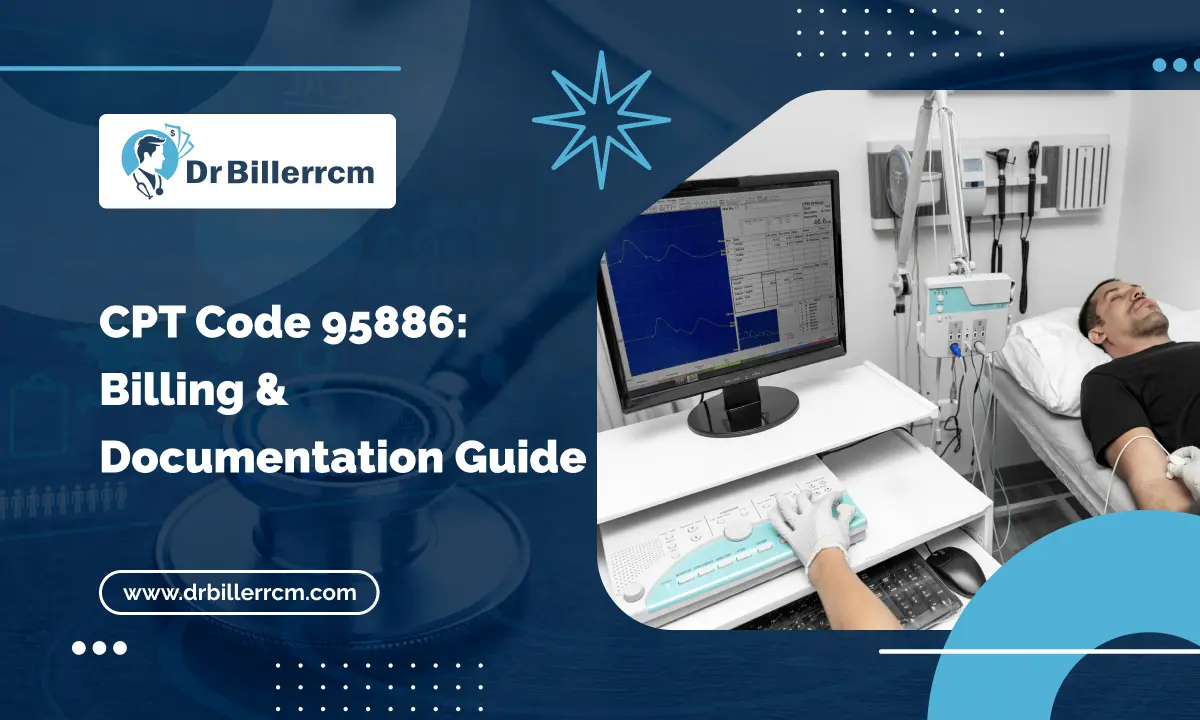
In practice, you perform a complete needle EMG of one arm or one leg. You evaluate 5 or more muscles in that limb, supplied by 3 or more nerves or 4 or more spinal levels. You also perform nerve conduction studies (NCS) on the same date, and you report 95886 in addition to your primary NCS codes (95907–95913).
Medicare and most payers treat 95886 as the “complete” EMG code. Code 95885 is the “limited” EMG (fewer than 5 muscles).
When to Use CPT 95886 and When Not To
Use cpt code 95886 when a complete EMG of one extremity is medically necessary, such as for radiculopathy, neuropathy, myopathy, or motor neuron disease workup. You must perform NCS (95907–95913) the same day and study 5 or more muscles in that limb from 3 or more nerves or 4 or more spinal levels. Your note should list the muscles, nerves or levels, and the clinical reason for testing.
Do not use 95886 when no NCS is done that day. In that case, use standalone EMG codes like 95860–95864 or 95867–95870. Do not use it when fewer than 5 muscles are studied in the extremity, because that is a limited study and should be coded as 95885 (with NCS). Also avoid 95886 when only paraspinal or other non‑extremity muscles are tested without an extremity EMG; other codes such as 95869 or 95870 may fit better. CPT codes 95860–95864 are still active; they are used for needle EMG when no nerve conduction study is performed that day.
Quick Code Choice for EMG/NCS
| Scenario | NCS Performed? | Muscles Studied in Extremity | Correct Code(s) |
| Complete EMG of one extremity with NCS | Yes | 5+ muscles, ≥3 nerves or ≥4 levels | 95907–95913 + 95886 |
| Limited EMG of one extremity with NCS | Yes | <5 muscles | 95907–95913 + 95885 |
| EMG without NCS (any muscle count) | No | Any | 95860–95864 or 95867–95870 (do not use 95885/95886) |
| Only paraspinal/non‑extremity muscles | NCS optional | No extremity EMG | Consider 95869/95870 or other non‑extremity codes |
How Many Units of 95886 Can You Bill?
Units depend on extremities, not time. One unit equals one complete EMG of one arm or one leg. You may report up to 4 units per day if all four extremities meet criteria (right arm, left arm, right leg, left leg). You cannot report more than one 95886 for the same extremity on the same date. Medicare’s medically unlikely edit (MUE) caps 95885 and 95886 combined at four units per patient per day, matching the number of extremities.
For a bilateral upper extremities emg (electromyography) cpt code scenario, imagine the right arm with 6 muscles (median/ulnar/radial nerves) and the left arm with 5 muscles (same nerves). That gives 2 units of 95886, plus your NCS codes. For a cpt code for lower extremity emg (electromyography) example, the right leg with 5 muscles (tibial/peroneal/femoral nerves) and the left leg with 6 muscles yields 2 units of 95886, plus NCS.
EMG Done with Nerve Conduction Studies (NCS)
This EMG‑with‑NCS link is essential. Medicare says to use 95885, 95886, 95887 for EMG only when NCS (95907–95913) are done the same day. If EMG is done without NCS, you must use codes like 95860–95864 or 95867–95870 instead.
Codes 95885–95887 are add‑on EMG codes that must ride on a primary NCS service. Billing 95886 without NCS on the same date is a common denial reason. So, if your emg test cpt code is 95886, the claim must also include NCS.
Modifiers You’ll Actually Use with 95886
Modifiers depend on who bills what (professional vs technical) and whether a separate E/M is done. Common modifiers include:
- Modifier 26 – Professional component only (physician interpretation).
- Modifier TC – Technical component only (equipment, staff, facility).
- Modifier 25 – Significant, separately identifiable E/M on the same day (for example, office visit plus EMG/NCS).
- Modifier 59 – Distinct procedural service, used when the EMG must be shown as separate from other same‑day procedures (use carefully and per payer rules).
Medicare treats 95886 as a PC/TC code, so splitting professional and technical with 26/TC is common in facility billing. Modifier 51 (multiple procedures) is not used with 95886 because it is an add‑on code.
Documentation That Stands Up to Audit
Payers and Medicare articles set clear expectations for 95886. Your note should include the clinical indication (symptoms and diagnosis such as weakness, numbness, radiculopathy, or neuropathy), plus the date of service and extremity tested (right/left, upper/lower).
You must list the muscles studied by name, with at least 5 muscles for that extremity, and document the nerves or spinal levels covered (3 or more nerves or 4 or more levels). The record should show NCS performed the same day, with codes 95907–95913 and key metrics (amplitude, latency, velocity), plus EMG findings (insertional activity, spontaneous activity, motor unit morphology, recruitment). Finally, include an interpretation that links findings to the diagnosis and plan.
Notes that only say “EMG normal/abnormal” without data are a known denial risk.
95886 Billing Mistakes and How to Avoid Them
| Mistake | Why It Happens | How to Fix It |
| Billing 95886 without NCS on the same day | Confusing standalone EMG codes with add‑on EMG+NCS codes | Use 95860–95864/95867–95870 when no NCS; reserve 95886 for same‑day NCS |
| Using 95886 for a limited study (<5 muscles) | Not checking muscle count per limb | If fewer than 5 muscles in that limb, use 95885 (with NCS) instead of 95886 |
| Billing more than one 95886 per extremity | Treating it like a time‑based code | Remember: 95886 = one unit per extremity, max 4 per day |
| Vague muscle/nerve documentation | Template notes that omit details | List each muscle, nerves/levels, and EMG/NCS data clearly |
| Wrong or missing modifiers (26/TC/25/59) | Not matching modifiers to setting and services | Use 26/TC for PC/TC split, 25 for significant E/M, and 59 only when truly distinct and allowed |
Reimbursement Snapshot
Rates vary by payer and location. Medicare’s national average for 95886 is typically around $90–$100 per unit under the Physician Fee Schedule, with non‑facility and facility rates in a similar range. Commercial payer rates can be higher or lower, so always check your contracts and local fee schedules.
Because 95886 is an add‑on code, total payment comes from NCS codes plus 95885/95886/95887 units.
Conclusion
Mastering CPT code 95886 comes down to three things: using it only for complete extremity EMG, always pairing it with same‑day nerve conduction studies, and documenting muscles, nerves/levels, and findings in detail. Get those right, and you’ll avoid the most common denials and audits around EMG/NCS billing.
If you want more practical billing guides like this, explore the rest of the resources at Dr Biller RCM.
FAQs
What is cpt code 95886 for?
cpt code 95886 is for a complete needle EMG of one arm or leg, done with nerve conduction studies the same day, evaluating 5 or more muscles from 3 or more nerves or 4 or more spinal levels.
What is the difference between CPT 95885 and 95886?
95885 = limited needle EMG of one extremity with NCS (<5 muscles).
95886 = complete needle EMG of one extremity with NCS (5+ muscles, 3+ nerves or 4+ levels).
Can CPT 95886 be billed alone?
No. The 95886 cpt code is an add‑on code that must be billed with a primary nerve conduction study code (95907–95913) on the same date. If no NCS is done, use standalone EMG codes instead.
What modifier is used for 95886?
Common modifiers are 26 (professional), TC (technical), 25 (separate E/M), and 59 (distinct procedure) when supported by documentation and payer policy.
Does CPT 95886 require a modifier?
A modifier is not always required, but it is often needed based on setting and billing arrangement. Examples include 26/TC in facility billing, 59 to bypass NCCI edits with NCS, and 25 when a significant E/M is also billed.
What diseases does a nerve conduction test show?
Nerve conduction studies help diagnose peripheral neuropathies (including diabetic neuropathy), compressive neuropathies like carpal tunnel syndrome, radiculopathies, plexopathies, and some neuromuscular junction or motor neuron disorders when read with EMG findings.