Are claim denials or documentation errors affecting your manual therapy reimbursements? Incorrect reporting of the 97140 CPT Code (Manual Therapy Techniques) can result in claim denials, delayed reimbursement, and compliance concerns. In CY 2026, CMS continues to classify CPT 97140 as a timed therapy service subject to Medicare therapy billing rules, including the $2,480 KX modifier threshold for physical therapy and speech-language pathology services combined. Accurate coding, documentation, and modifier selection remain essential for payment.
What should providers know before billing CPT 97140? This guide explains the 97140 CPT code description, covered manual therapy techniques, documentation standards, billing guidelines, modifier requirements, reimbursement considerations, NCCI edits, and Medicare compliance. It also reviews common billing mistakes, documentation expectations, and practical steps to reduce coding errors and support clean claim submission. Under the CY 2026 Medicare Physician Fee Schedule, CMS updated therapy policies and payment rules while maintaining its focus on payment accuracy and compliant reporting.
Whether you are a Physical Therapist (PT), Occupational Therapist (OT), medical biller, Certified Professional Coder (CPC), practice manager, or healthcare provider, this article provides practical guidance to help you report Manual Therapy CPT Code 97140 correctly.
What Is the 97140 CPT Code (Manual Therapy Techniques)?
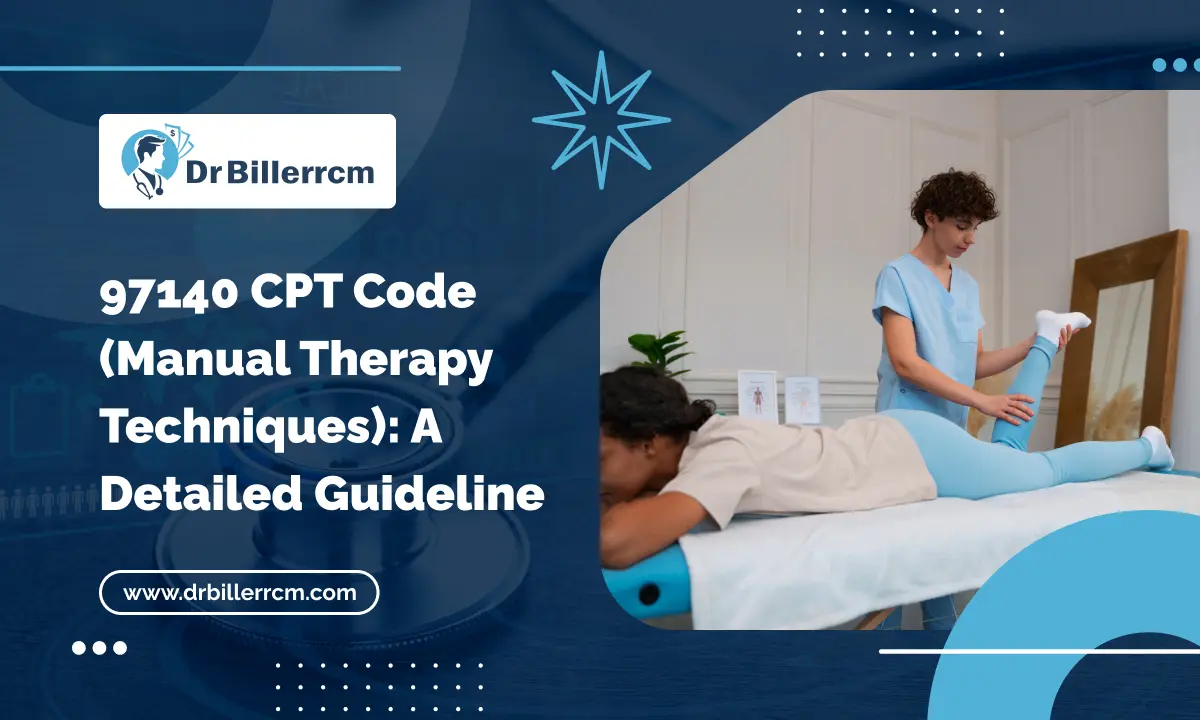
The 97140 CPT Code (Manual Therapy Techniques) is a timed therapeutic procedure reported in 15-minute, one-on-one increments. According to the American Medical Association (AMA), it describes manual therapy techniques, including mobilization/manipulation, manual lymphatic drainage, and manual traction, performed on one or more body regions. These techniques are intended to reduce pain, improve joint and soft tissue mobility, decrease swelling, and restore functional movement.
As a timed service, providers must document the total treatment time and demonstrate that the intervention was medically necessary. Medicare and many commercial payers also need evidence of the patient’s condition, functional limits, treatment goals, skilled intervention, and response to care before reimbursement. Accurate reporting helps reduce claim denials and supports compliance with CMS therapy billing requirements.
Manual Therapy Techniques Included Under CPT 97140
CPT 97140 includes one or more of the following manual therapy techniques when performed by a qualified healthcare professional:
Joint Mobilization and Manipulation: Manual techniques used to improve joint motion, reduce stiffness, and relieve pain.
Soft Tissue Mobilization: Hands-on treatment of muscles, fascia, tendons, and ligaments to improve tissue mobility and reduce restrictions.
Manual Lymphatic Drainage (MLD): A gentle technique that promotes lymphatic flow and helps manage lymphedema or post-surgical swelling.
Manual Traction: Controlled manual force applied to the cervical or lumbar spine to reduce pressure on affected structures and improve mobility.
When Should CPT Code 97140 Be Used?
Correct use of 97140 CPT Code (Manual Therapy Techniques) depends on medical necessity, direct patient care, and compliance with time-based billing rules. This section explains when the code is appropriate and the documentation needed to support reimbursement.
Medical Necessity Requirements
CPT 97140 should be reported only when manual therapy is medically necessary to evaluate and treat a functional impairment or physical condition. The service must require the skills of a qualified healthcare professional and be supported by the patient’s diagnosis, clinical findings, and treatment plan.
Documentation should clearly include:
- The patient’s diagnosis and functional limitations.
- The body region treated.
- The manual therapy technique performed.
- Treatment goals and expected outcomes.
- The patient’s response and progress during the visit.
One-on-One Patient Contact
The Manual Therapy CPT Code is a constant attendance service. A qualified provider must deliver the treatment through direct, one-on-one contact with the patient for the entire billed time.
Examples include:
- Joint mobilization of the shoulder to improve range of motion.
- Manual lymphatic drainage to reduce edema.
- Manual traction for spinal conditions.
- Soft tissue mobilization to decrease muscle restrictions.
Time-Based Service Requirements
The 97140 CPT Code (Manual Therapy Techniques) is reported in 15-minute units and follows Medicare’s timed-service billing rules. Providers should document the total minutes spent delivering manual therapy and bill only the units supported by the recorded treatment time.
To support accurate claims:
- Record the total one-on-one treatment minutes.
- Report units according to the applicable timed-service rules.
- Document start and stop times or the total treatment time, as required by payer policy.
- Keep treatment records consistent with the billed units and the patient’s medical record.
Documentation Requirements for CPT Code 97140
Complete documentation is essential for accurate billing and medical necessity. This section explains the records providers should maintain to support CPT Code 97140 claims and reduce the risk of denials or audit findings.
Required Documentation Elements
Documentation for 97140 CPT Code (Manual Therapy Techniques) should clearly demonstrate that the service required the skills of a qualified healthcare professional and was medically necessary. CMS expects therapy records to support the patient’s functional limitations, the skilled intervention provided, and the billed treatment time.
Each treatment note should include:
1. Patient diagnosis and functional deficits.
2. Specific manual therapy technique performed (e.g., joint mobilization, manual traction, or manual lymphatic drainage).
3. Anatomical region(s) treated.
4. Objective findings, such as range of motion, pain scores, edema, or joint mobility.
5. Total one-on-one treatment minutes supporting the billed units.
6. Patient response, progress toward goals, and the plan for continued care.
SOAP Note Example
A structured SOAP note helps demonstrate skilled care and supports compliant billing.
Subjective (S): Patient reports persistent right shoulder pain rated 6/10 with difficulty reaching overhead.
Objective (O): Performed 15 minutes of grade III glenohumeral joint mobilization and soft tissue mobilization. Shoulder flexion improved from 120° to 135° following treatment.
Assessment (A): Patient showed improved joint mobility and reduced pain. Continued skilled manual therapy remains medically necessary.
Plan (P): Continue manual therapy twice weekly, monitor range of motion, and progress therapeutic exercises as tolerated.
Documentation Errors That Cause Claim Denials
Incomplete or inconsistent records frequently result in denied or delayed claims. Common documentation mistakes include:
1. Missing treatment time or unsupported billed units.
2. Failure to identify the manual therapy technique performed.
3. Descriptions of the treatment area are unclear.
4. No objective measurements or functional progress.
5. Insufficient evidence of medical necessity.
6. Billing services without documenting direct one-on-one patient care.
Medicare Billing Guidelines for CPT Code 97140
Medicare applies specific billing and documentation requirements to CPT Code 97140 because it is a timed therapy service. Understanding these rules helps providers submit compliant claims, reduce denials, and support appropriate reimbursement.
Medicare Coverage Rules
Medicare covers CPT Code 97140 when the service is reasonable, medically necessary, and provided by or under the supervision of a qualified healthcare professional, consistent with Medicare coverage requirements.
Documentation must support the patient’s diagnosis, functional limitations, treatment goals, skilled intervention, and clinical progress throughout the plan of care.
To support compliant billing:
- Document the medical necessity of each treatment session.
- Identify the manual therapy technique and anatomical region treated.
- Record the patient’s functional improvement or response to treatment.
- Ensure the billed units match the documented treatment time.
The 8-Minute Rule
CPT 97140 is reported in 15-minute units and follows Medicare’s 8-minute rule for timed therapy services. Providers may bill one unit only when at least 8 minutes of direct, one-on-one manual therapy has been provided.
When multiple timed therapy services are furnished during the same visit, the total treatment minutes determine the total billable units according to Medicare billing guidelines.
Unit Calculation Examples
Examples of Medicare unit reporting include:
8–22 minutes: Bill 1 unit of CPT 97140.
23–37 minutes: Bill 2 units.
38–52 minutes: Bill 3 units.
53–67 minutes: Bill 4 units.
CPT Code 97140 Modifier Guidelines
Correct modifier selection is essential for accurate reimbursement and compliance with National Correct Coding Initiative (NCCI) edits. The table below summarizes the modifiers commonly reported with the 97140 CPT Code (Manual Therapy Techniques) and when each modifier may be appropriate.
| Modifier | Description | When to Use |
| 59 | Distinct Procedural Service | Append when CPT 97140 is performed as a separate and distinct service from another procedure on the same date, and no more specific X modifier applies. |
| XS | Separate Structure | Use when manual therapy is performed on a different anatomical structure than the other billed procedure. |
| XE | Separate Encounter | Report when the manual therapy service occurs during a separate patient encounter on the same day. |
| XP | Separate Practitioner | Use when different qualified healthcare professionals perform separate services on the same day. |
| XU | Unusual Non-Overlapping Service | Report when the manual therapy service does not overlap with another procedure and represents a distinct service. |
| GP | Append when CPT 97140 is furnished as part of a physical therapy plan of care. | Append when CPT 97140 is furnished as part of a physical therapy plan of care. |
| GO | Services Delivered Under an Occupational Therapy Plan of Care | Use when the service is provided under an occupational therapy plan of care. |
| CQ | Services Furnished in Whole or in Part by a Physical Therapist Assistant (PTA) | Append when Medicare’s PTA payment rules require reporting services furnished in whole or in part by a PTA. |
| CO | Services Furnished in Whole or in Part by an Occupational Therapy Assistant (OTA) | Append when Medicare’s OTA payment rules apply. |
Conclusion
Accurate reporting of the 97140 CPT Code (Manual Therapy Techniques) depends on complete documentation, appropriate modifier selection, compliance with Medicare billing rules, and clear evidence of medical necessity. Following CMS and payer requirements helps reduce claim denials, support reimbursement, and strengthen audit readiness.
Healthcare providers, therapists, medical billers, and coding professionals should regularly review coding updates, payer policies, and documentation standards to maintain compliant billing practices. Applying these guidelines consistently can improve claim accuracy and support efficient revenue cycle performance.
FAQs
What is the 97140 CPT Code (Manual Therapy Techniques) used for?
The 97140 CPT Code (Manual Therapy Techniques) reports one-on-one manual therapy services provided in 15-minute increments. It includes joint mobilization, soft tissue mobilization, manual lymphatic drainage, and manual traction to improve function and reduce pain.
Is CPT Code 97140 a timed code?
Yes. CPT 97140 is a timed therapy code billed in 15-minute units and follows Medicare’s 8-minute rule. Providers must document the total one-on-one treatment time to support the units billed.
Which modifiers are commonly used with CPT Code 97140?
Common modifiers include 59, XE, XS, XP, XU, GP, GO, CQ, and CO, depending on the clinical situation and payer requirements. The selected modifier must be supported by clear documentation and medical necessity.
What documentation is required to bill CPT Code 97140?
Documentation should include the patient’s diagnosis, functional limitations, manual therapy technique, anatomical region treated, treatment time, objective findings, and response to care.
Can CPT Code 97140 and CPT Code 97110 be billed together?
Yes. CPT 97140 and CPT 97110 may be billed together when they represent separate, medically necessary services and comply with NCCI edit requirements. The medical record should clearly distinguish each service, and an appropriate modifier should be appended when required.