
A claim can be denied even when the procedure itself was medically necessary and correctly documented. One common reason is a mismatch between the procedure code and the modifier reported on the claim.
So, what does the CO-4 denial code actually mean? Why does Medicare use it, which modifiers commonly trigger it, and what should your billing team do when it appears on an ERA or EOB?
The CO-4 denial code indicates that the procedure code is inconsistent with the modifier used or that a required modifier is missing. The key to resolving it is not simply adding a modifier. You need to determine what the procedure requires, whether the modifier is supported by the documentation, and whether the payer’s coding rules allow that combination.
What Is the CO-4 Denial Code?
CO-4 refers to Claim Adjustment Reason Code (CARC) 4:
The procedure code is inconsistent with the modifier used or a required modifier is missing.
X12 maintains the standard CARC code set, while CMS uses CARCs to identify the detailed reason for an adjustment or denial. This means a CO-4 denial generally points to a claim-line coding problem, rather than a problem with the patient’s eligibility or the medical necessity of the service.
CO-4 at a glance
| Code | Meaning |
| CO | Contractual Obligation |
| 4 | Procedure code is inconsistent with the modifier used or a required modifier is missing |
| Main issue | Modifier and procedure-code combination |
| Typical action | Review coding, documentation, payer rules, correct the claim, and resubmit when appropriate |
The exact reason behind the CO-4 should be confirmed from the accompanying Remittance Advice Remark Code (RARC) and the payer’s claim details.
What Is the CO-4 Denial Code Reason?
The main CO-4 denial code reason is an incorrect, missing, or incompatible modifier. There are several ways this can happen:
- A required modifier was left off the claim.
- A modifier was added even though the procedure does not support it.
- Two modifiers were reported together when the combination is not valid.
- The procedure code requires a specific modifier under a payer policy.
- The modifier does not accurately describe how or where the service was performed.
- A modifier was used to bypass an edit without sufficient documentation.
- The claim contains a procedure and modifier combination that conflicts with Medicare coding rules.
What Are the Commonly Used Remark Codes for CO-4?
A CARC gives the general adjustment reason. A RARC provides additional information about that adjustment. X12 explains that RARCs are used to provide additional explanation for an adjustment already described by a CARC. Some RARCs commonly associated with modifier-related CO-4 situations include:
| Remark code | Meaning | What it tells the biller |
| N517 | Resubmit a new claim with the requested information | The claim needs corrected information |
| N519 | Invalid combination of HCPCS modifiers | The modifiers reported together are not valid |
| N572 | Procedure is not payable unless appropriate reporting codes and modifiers are submitted | Additional reporting codes and modifiers may be required |
| N657 | This should be billed with the appropriate code for these services | Review the coding used for the service |
CMS documentation has specifically paired CARC 4 with N519 for invalid HCPCS modifier combinations and with N572 in situations where appropriate reporting codes and modifiers are required.
CO-4 and N519: What Does It Mean?
One of the most useful combinations to understand is: CO-4 + N519
N519 means: Invalid combination of HCPCS modifiers.
In practical terms, the payer is telling you that the modifiers reported on the claim line do not form an acceptable combination for that procedure.
For example, a billing team might attach multiple modifiers to a procedure without confirming whether each one is appropriate or whether the modifiers can be reported together.
The solution is not to remove modifiers randomly. Review the procedure, the circumstances of the service, the documentation, and the payer’s coding requirements before rebuilding the claim.
CMS has used the CO-4/N519 combination for Medicare claims involving invalid modifier combinations.
What Is the Medicare Denial Code CO-4?
The Medicare denial code CO-4 follows the same basic CARC definition: the procedure code is inconsistent with the modifier used or a required modifier is missing. Medicare claims can trigger this adjustment when a service requires a particular modifier or when the modifier submitted does not match the applicable coding rules.
CMS provides an example involving Medicare claims that were returned as unprocessable because a required modifier was missing. The resulting message included CARC 4.
Medicare’s National Correct Coding Initiative (NCCI) is also important when investigating modifier-related claim edits. NCCI procedure-to-procedure edits can deny one procedure when two codes are reported together unless an appropriate modifier is reported and the clinical circumstances support its use.
How to Fix a CO-4 Denial
The CO-4 denial code solution starts with identifying exactly what the payer rejected.
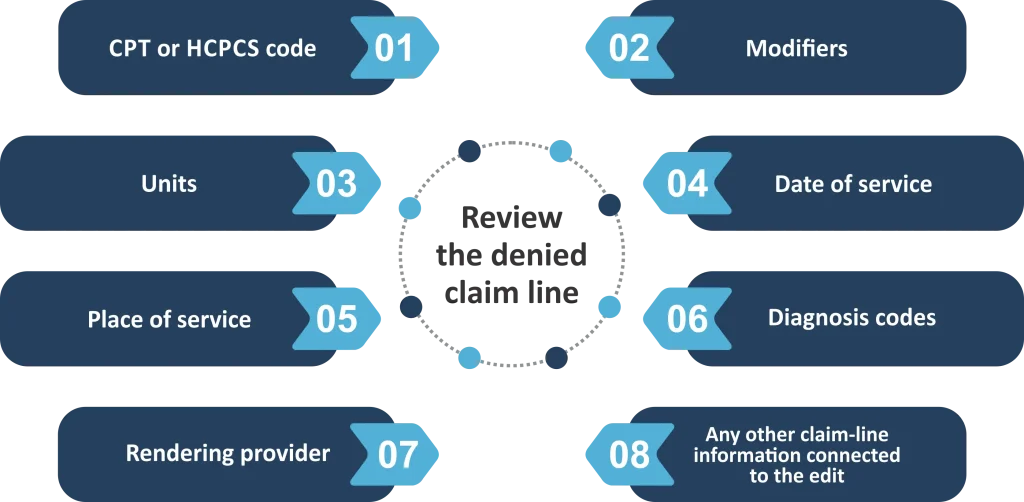
1. Review the denied claim line
Start with the procedure code that received the adjustment. Check:
- CPT or HCPCS code
- Modifiers
- Units
- Date of service
- Place of service
- Diagnosis codes
- Rendering provider
- Any other claim-line information connected to the edit
If the issue appears to be related to coding or modifier selection, review the claim with your medical coding team before making a correction.
2. Read the RARC
The CO-4 tells you that the problem involves the procedure code and modifier. The accompanying RARC can provide a more specific explanation. For example, N519 points toward an invalid combination of HCPCS modifiers.
This distinction can save time because the biller can investigate the specific modifier issue instead of treating the claim as a generic coding denial.
3. Verify whether a modifier is actually required
Check the applicable coding guidance and payer policy. CMS’s Medicare claim guidance states that modifiers should be reported when they apply to the service. Its CMS-1500 guidance also notes that HCPCS code modifiers can be reported with the procedure code.
If a modifier is required and the documentation supports it, correct the claim accordingly.
4. Confirm that the modifier matches the service
A modifier should describe the actual circumstances of the service. For example, CMS coverage guidance identifies situations in which laterality modifiers such as RT and LT are required for applicable unilateral procedures, while bilateral procedures may require the appropriate bilateral reporting method.
The correct modifier depends on the procedure and circumstances. Never select one simply because it has previously caused a claim to pay.
5. Check modifier combinations
If the denial includes N519, review every modifier on the affected line. Ask:
- Are all modifiers necessary?
- Is any modifier incompatible with another?
- Does the procedure support the reported modifier?
- Is the modifier sequence appropriate?
- Does Medicare or the commercial payer have a specific rule for this combination?
Remove unsupported modifiers and retain only those justified by the service and documentation.
6. Check Medicare NCCI edits when applicable
For Medicare claims, review the applicable NCCI edit when the procedure is part of a code combination that may require a modifier.
CMS explains that NCCI procedure-to-procedure edits are designed to prevent inappropriate payment when certain services should not be reported together. An appropriate modifier can allow payment of the Column Two service when the clinical circumstances support separate reporting.
This is particularly important because adding modifier 59 or another modifier does not automatically override an edit. The circumstances must support the modifier.
7. Correct and resubmit when appropriate
If the claim was rejected because of a correctable coding or modifier error, submit a corrected claim according to the payer’s requirements.
CMS has published examples where CARC 4 was used for claims returned as unprocessable because a required modifier was missing. In those situations, the appropriate response is correction and resubmission rather than repeatedly submitting the same claim.
If the claim was coded correctly, investigate the payer’s edit before making changes. A coding change that is not supported by the medical record can create a different compliance problem.
Common Causes of CO-4 Denials
Although payer edits vary, most CO-4 investigations come back to a small number of issues.
- Missing modifier: The procedure requires a modifier, but none was reported.
- Incorrect modifier: A modifier was included, but it does not accurately describe the service.
- Invalid modifier combination: Two or more modifiers were reported together even though the combination is not accepted.
- Modifier does not match the procedure: The modifier may be valid in general but inappropriate for the specific CPT or HCPCS code.
- NCCI-related issue: The procedure combination may require an appropriate modifier when separate reporting is clinically justified.
- Payer-specific coding rule: A commercial payer may apply a coding policy that differs from another payer’s processing rules. The claim should therefore be reviewed against the applicable payer policy rather than relying solely on a previous claim.
A Simple CO-4 Denial Example
Suppose a provider submits a procedure code with two HCPCS modifiers. The payer processes the claim and returns:
CO-4: Procedure code is inconsistent with the modifier used or a required modifier is missing.
N519: Invalid combination of HCPCS modifiers.
The billing team should not immediately appeal the claim. Instead, the team should:
- Identify the affected procedure line.
- Review both modifiers.
- Determine why each modifier was reported.
- Check whether the modifiers can be used together.
- Compare the claim with the medical record.
- Review the applicable payer or Medicare coding guidance.
- Correct the claim if an error is confirmed.
- Resubmit according to the payer’s instructions.
This approach addresses the coding problem instead of repeatedly sending the same claim.
How to Prevent CO-4 Denials
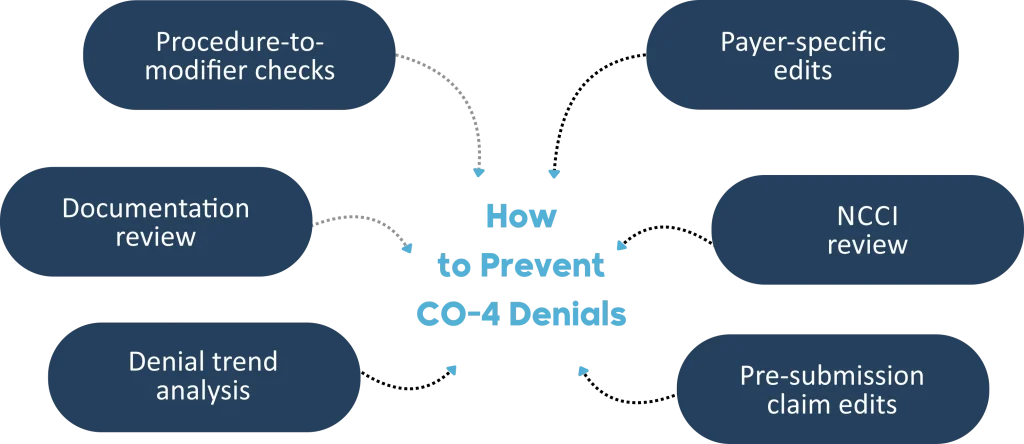
The best CO-4 strategy is prevention. Before claims are submitted, billing and coding teams should review modifier requirements for frequently billed procedures and identify recurring payer edits. A useful prevention process includes:
Procedure-to-modifier checks: Confirm that frequently billed CPT and HCPCS codes are paired with appropriate modifiers.
Payer-specific edits: Maintain current payer rules for procedures that commonly trigger modifier denials.
Documentation review: Make sure the medical record supports the circumstances represented by the modifier.
NCCI review: For Medicare claims, check applicable NCCI edits before adding a modifier to bypass an edit.
Denial trend analysis: Track CO-4 denials by provider, procedure, modifier, and payer to identify repeat problems.
Pre-submission claim edits: Use billing-system edits to flag potentially invalid modifier combinations before claims reach the payer.
Effective denial management should address both the rejected claim and the process that caused the error.
When Should a CO-4 Claim Be Corrected Instead of Appealed?
A CO-4 claim should generally be investigated before deciding whether an appeal is appropriate. If the claim contains a genuine modifier or coding error, correcting and resubmitting the claim may be the appropriate path.
If the original coding was accurate and the payer incorrectly applied its edit, the next step may be to contact the payer or follow its appeal process, depending on the remittance instructions.
The important point is to identify the cause before choosing the action. An appeal will not fix a claim that actually contains an incorrect modifier, while automatically changing a valid modifier can create a new coding problem.
How CO-4 Affects Medical Billing and A/R
A single modifier denial may look minor, but recurring CO-4 adjustments can create avoidable work for a billing team. Each denial can require claim review, coding verification, payer research, correction, resubmission, and follow-up.
That makes CO-4 useful as a denial trend indicator. If the same procedure and modifier combination repeatedly produces CO-4 adjustments, the underlying billing workflow should be reviewed rather than handling each denial individually.
A structured denial management process can help practices identify recurring coding problems and prevent the same issue from reaching the payer again. Dr Biller RCM’s denial management services can support denial analysis, root-cause identification, claim correction, and prevention workflows.
Final Takeaway
The CO-4 denial code means the procedure code is inconsistent with the modifier used or that a required modifier is missing. The CARC identifies the broad problem, while the accompanying remark code can provide more specific information about what needs to be corrected.
For example, N519 indicates an invalid combination of HCPCS modifiers, while other remark codes may point toward missing information or additional reporting requirements.
The most effective CO 4 denial code solution is to review the affected claim line, read the accompanying remark code, verify the procedure and modifier combination against applicable coding rules, confirm that the documentation supports the modifier, and then correct or challenge the claim based on what the review shows.
Frequently Asked Questions About CO-4 Denial Code
What does CO-4 mean in medical billing?
CO-4 means the procedure code is inconsistent with the modifier used or that a required modifier is missing. X12 defines CARC 4 with this description.
What is the CO 4 denial code reason?
The primary reason is a mismatch between a procedure code and its modifier, an invalid modifier combination, or a missing required modifier.
What is the CO 4 denial code solution?
Review the denied claim line, identify the modifier issue from the accompanying remark code, verify the applicable coding rules and documentation, correct the claim when necessary, and resubmit according to payer requirements.
What does Medicare denial code CO-4 mean?
For Medicare, CO-4 indicates that the procedure code is inconsistent with the modifier used or that a required modifier is missing. CMS has documented Medicare claim-processing situations where CARC 4 is used for missing or incorrect modifiers.
What does CO-4 with N519 mean?
CO-4 with N519 generally indicates that the claim has a procedure/modifier issue and that the submitted HCPCS modifiers form an invalid combination. CMS defines N519 as “Invalid combination of HCPCS modifiers.”
Is CO-4 always caused by a missing modifier?
No. CARC 4 can indicate either that a required modifier is missing or that the modifier used is inconsistent with the procedure.