
Have you ever posted a Medicare payment and found that the amount received is slightly lower than the expected Medicare payment, even though the claim was processed correctly?
That difference may be sequestration. It is not necessarily a coding error, underpayment, or claim denial. For applicable Medicare Fee-for-Service claims, sequestration is a federally required reduction in the Medicare payment amount. CMS states that the current Medicare FFS sequestration rate is 2%, with the reduction applied after applicable deductible, coinsurance, and Medicare Secondary Payer adjustments.
So, what is sequestration in medical billing, how is the sequestration amount calculated, and what does CO-253 mean on a remittance advice? Understanding these details helps billing teams post payments correctly and avoid treating an automatic federal payment reduction like a denial that needs to be appealed.
What Is Sequestration in Medical Billing?
Sequestration in medical billing is a federally mandated reduction in applicable Medicare payments. The reduction originated from federal budget-control legislation and affects Medicare benefit payments under the applicable sequestration rules.
For Medicare Fee-for-Service, CMS states that claims with dates of service or discharge on or after April 1, 2013, generally incur a 2% reduction in Medicare payment. The reduction applies after Medicare determines applicable deductible, coinsurance, and Medicare Secondary Payer adjustments.
Is Sequestration a Denial?
No. Sequestration is a payment reduction, not a conventional claim denial. The claim can be correctly adjudicated and paid while the Medicare payment is reduced by the applicable sequestration amount.
What Is a Sequestration Reduction?
A sequestration reduction in medical billing is the amount deducted from an applicable Medicare payment under the federal sequestration rules.
For Medicare FFS claims, the current rate is 2%. CMS explains that beneficiary deductible and coinsurance amounts are not themselves reduced by sequestration. Instead, the reduction is applied to the Medicare payment after those amounts have been determined. For example, suppose Medicare determines that:
- Medicare-approved amount: $100
- Patient deductible: $0
- Patient coinsurance: $20
- Medicare payment before sequestration: $80
- Sequestration at 2%: $1.60
- Medicare payment after sequestration: $78.40
The patient does not become responsible for the $1.60 reduction simply because Medicare applied sequestration.
What Is a Sequestration Adjustment in Medical Billing?
A sequestration adjustment is the payment adjustment that reflects the federal reduction. It may appear on Medicare remittance information as an adjustment associated with CARC 253. X12 defines Claim Adjustment Reason Code 253 as:
“Sequestration – reduction in federal payment.”
CMS also includes CARC 253 in its claims-processing materials and identifies it as the sequestration reduction in federal payment.
What Is the Sequestration Code?
The sequestration code most commonly associated with Medicare claim adjustments is CARC 253.
What Does CO-253 Mean?
CO-253 combines:
- CO: Contractual Obligation
- 253: Sequestration, reduction in federal payment
CMS remittance guidance identifies CO as a contractual-obligation group code and 253 as the sequestration adjustment reason. Although billing teams sometimes call it the CO-253 denial code, it is more accurate to describe it as a payment adjustment rather than a traditional denial.
Should You Resubmit a CO-253 Claim?
No. A CO-253 adjustment by itself does not indicate that the claim needs to be corrected and resubmitted. It reflects the applicable federal payment reduction. Instead, the billing team should:
- Confirm that the adjustment is actually related to sequestration.
- Verify the calculation against the Medicare payment amount.
- Post the adjustment correctly.
- Reconcile the remittance with the expected payment.
- Avoid treating the amount as a patient balance unless applicable payer rules specifically support patient responsibility.
How Is Medicare Sequestration Calculated?
Understanding how Medicare sequestration is calculated is essential for payment posting and reconciliation. For an applicable Medicare FFS claim, the basic calculation is:
Sequestration amount = Medicare payment subject to sequestration × 2%
The Medicare payment subject to sequestration is determined after applicable deductible, coinsurance, and Medicare Secondary Payer adjustments. CMS’s FFS guidance illustrates this calculation directly.
Does Sequestration Reduce Patient Responsibility?
No. CMS states that beneficiary deductible and coinsurance payments are not subject to the 2% Medicare FFS sequestration reduction. The reduction affects the Medicare payment rather than shifting the reduction to the beneficiary’s deductible or coinsurance obligation.
That distinction is important during payment posting.
For example, if a patient’s calculated coinsurance is $20 and Medicare’s payment is $80 before sequestration, the patient does not become responsible for the additional $1.60 created by the 2% reduction.
The provider receives the reduced Medicare payment, while the beneficiary’s applicable cost-sharing remains determined under the normal Medicare rules.
Does Sequestration Apply to Medicare Part A and Part B?
Yes, Medicare sequestration can affect applicable Part A and Part B benefit payments. CMS states that Medicare FFS claims generally incurred a 2% payment reduction beginning with dates of service or discharge on or after April 1, 2013. CMS also specifically identifies the reduction as applying to Medicare Part A and Part B payments.
This can affect different types of providers and services, including applicable physician, outpatient, inpatient, DME, and other Medicare FFS payments.
Does Sequestration Apply to Medicare Advantage?
Yes, but the way it applies is different from the familiar Medicare FFS claim-level adjustment. This is one area where medical billing articles often oversimplify the answer.
CMS has issued specific guidance stating that sequestration applies to Medicare Advantage plan payments. Current CMS payment information continues to state that the 2% sequestration rate was restored effective July 1, 2022, and remains in effect.
However, that does not mean every Medicare Advantage provider claim should automatically be treated like a Medicare FFS claim with CO-253.
Medicare Advantage plans are operated by private organizations under contracts with Medicare. The plan receives Medicare payments from CMS, and sequestration can affect those program payments. CMS also has specific rules for payments to non-contract providers under Medicare Advantage.
Therefore, when a provider receives a Medicare Advantage remittance, the billing team should follow the specific plan’s payment and contractual rules rather than automatically applying the Medicare FFS CO-253 workflow.
Medicare FFS vs. Medicare Advantage Sequestration
| Area | Medicare FFS | Medicare Advantage |
| Sequestration applies? | Yes, under applicable Medicare FFS rules | Yes, at the Medicare program payment level |
| Common claim-level CARC | 253 | Do not automatically assume CARC 253 applies |
| Payer | Medicare FFS/MAC | Medicare Advantage organization |
| Provider payment rules | Medicare FFS rules | Plan contract and applicable MA rules |
| Billing approach | Follow Medicare FFS remittance guidance | Follow the MA plan’s remittance and contract terms |
The safest operational rule is simple: do not assume that a Medicare Advantage payment reduction should be posted exactly like a Medicare FFS CO-253 adjustment.
When Did the 2% Medicare Sequestration Reduction Start?
The original Medicare FFS sequestration reduction began on April 1, 2013.
CMS temporarily suspended the Medicare sequestration reduction during the COVID-19 period. CMS records show that the suspension lasted through March 31, 2022. A 1% reduction applied from April 1 through June 30, 2022, and the original 2% rate was restored effective July 1, 2022. CMS’s current 2026 Medicare Advantage payment information confirms that the 2% rate remains in effect.
This historical timeline matters because older remittance records may show different treatment during the suspension and reduced-rate periods.
What Is the Sequestration Amount on a Remittance Advice?
The sequestration amount is the dollar value of the payment reduction applied under the applicable sequestration rule. For a simple Medicare FFS example:
Medicare payment before sequestration: $500
Sequestration rate: 2%
Sequestration amount: $10
Payment after sequestration: $490
The $10 difference is not necessarily an underpayment requiring payer follow-up.
How Should Billing Teams Handle a Sequestration Adjustment?
Accurate payment posting is the main operational issue.
1. Identify the Adjustment
Review the ERA or remittance advice and determine whether the reduction is identified with the appropriate adjustment information, such as CARC 253.
2. Compare the Payment With the Expected Amount
Calculate the expected Medicare payment before sequestration and determine whether the reduction is consistent with the applicable percentage.
3. Post the Adjustment Correctly
The sequestration amount should be recorded separately from patient responsibility and other contractual adjustments when required by the organization’s accounting and billing workflow.
4. Do Not Automatically Create Patient Responsibility
Because sequestration reduces the applicable Medicare payment, the adjustment should not simply be transferred to the patient’s balance.
5. Monitor for Unexpected Variances
If the amount appears inconsistent with the claim or applicable payment rules, investigate the remittance before writing off the difference.
For practices dealing with frequent payment variances, accurate medical billing and payment posting workflows can help separate legitimate contractual adjustments from true underpayments, denials, and posting errors.
Common Sequestration Billing Mistakes
Sequestration is straightforward once the payment sequence is understood, but several posting mistakes can create unnecessary work.
Treating CO-253 as a Regular Denial
CARC 253 describes a reduction in federal payment. Treating every CO-253 adjustment as a claim denial can lead to unnecessary resubmissions.
Applying 2% to the Total Billed Charge
The 2% reduction is not simply calculated from the provider’s original billed amount.
For Medicare FFS, CMS explains that the adjustment is applied after applicable deductible, coinsurance, and Medicare Secondary Payer adjustments.
Billing the Patient for the Reduction
The sequestration amount should not automatically become additional patient responsibility.
Ignoring the Remittance Advice
The remittance advice provides the information needed to understand how the payment was calculated. Posting only the deposit amount without reviewing the adjustment details can make reconciliation difficult.
Assuming Every Medicare Payment Uses the Same Rule
Medicare FFS, Medicare Advantage, and other Medicare payment arrangements can have different payment mechanics. Billing teams should verify the applicable program and payer before applying a standard sequestration workflow.
How Sequestration Affects Revenue Cycle Management
A 2% reduction may seem small on an individual claim, but practices with significant Medicare volume should account for it when analyzing expected versus actual collections. For example, if a practice has $100,000 in Medicare payments subject to a 2% sequestration reduction, the corresponding reduction would be approximately $2,000 before considering claim-specific payment rules and exceptions.
That does not mean the practice should attempt to recover the $2,000 through additional patient billing. Instead, the amount should be incorporated into realistic payment forecasting and reconciliation. This is where strong revenue cycle management becomes important.
Billing teams should distinguish between:
- Expected sequestration adjustments
- True underpayments
- Coding-related reductions
- Denials
- Rejections
- Patient responsibility
- Other contractual adjustments
Separating these categories makes A/R reporting more accurate and helps staff focus their follow-up efforts on amounts that can actually be recovered.
For practices that need help identifying payment discrepancies and recurring revenue leakage, denial management and appeals support can help analyze claim issues and distinguish actionable denials from routine payment adjustments.
Example: How CO-253 Appears in Practice
Suppose Medicare processes a claim and determines that the provider’s payment before sequestration is $300. The applicable sequestration rate is 2%.
$300 × 0.02 = $6
The provider therefore receives: $300 − $6 = $294
The $6 adjustment may be reported with CARC 253, depending on the remittance and applicable claim-processing rules.
The billing team should not interpret the $6 reduction as evidence that the claim was denied. Instead, it should reconcile the $294 payment with the $300 pre-sequestration amount and post the $6 sequestration adjustment appropriately.
How to Manage Sequestration More Effectively
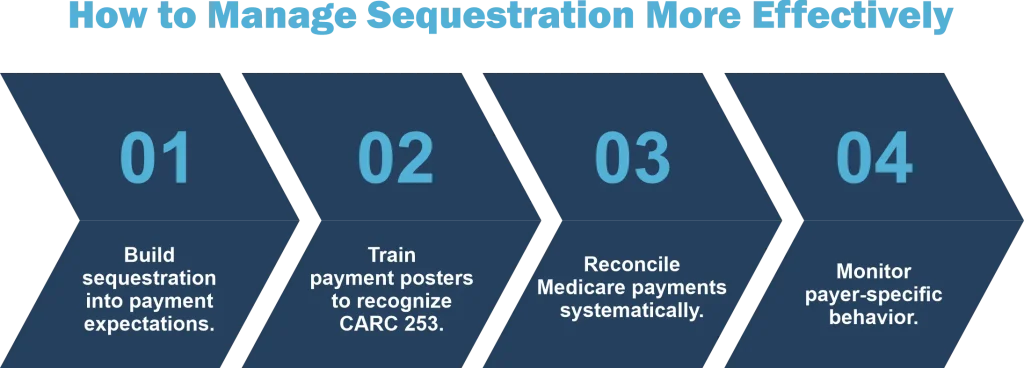
Providers cannot eliminate a legally required sequestration reduction through better coding or claim resubmission. They can, however, make the revenue-cycle process around it more accurate. A practical approach is to:
- Build sequestration into payment expectations.
Do not forecast applicable Medicare payments as though the full pre-sequestration amount will always be deposited. - Train payment posters to recognize CARC 253.
This reduces the risk of treating routine adjustments as denials. - Separate sequestration from true revenue leakage.
A federally required reduction is fundamentally different from an avoidable coding error or underpayment. - Reconcile Medicare payments systematically.
Expected payment, patient responsibility, contractual adjustments, sequestration, and actual deposits should be traceable. - Monitor payer-specific behavior.
Medicare FFS and Medicare Advantage should not automatically be processed using the same assumptions.
Final Takeaway
So, what is sequestration in medical billing? It is a federally mandated reduction in applicable Medicare payments, not a routine claim denial. For Medicare FFS, the current sequestration rate is generally 2%, and the reduction is applied after applicable deductible, coinsurance, and Medicare Secondary Payer adjustments.
When CARC 253 or CO-253 appears on a remittance, billing teams should recognize it as a sequestration-related payment adjustment rather than automatically treating it as a claim that needs correction.
The most important step is accurate reconciliation. Understand the pre-sequestration Medicare payment, calculate the applicable reduction, post it correctly, and keep it separate from genuine denials, underpayments, and patient responsibility.
Frequently Asked Questions
What is sequestration in medical billing?
Sequestration is a federally mandated reduction in applicable Medicare payments. For Medicare FFS, the current reduction is generally 2% and is applied after applicable deductible, coinsurance, and Medicare Secondary Payer adjustments.
What is sequestration reduction in medical billing?
A sequestration reduction is the amount deducted from an applicable Medicare payment under federal sequestration rules. For Medicare FFS, the current rate is 2%.
What does CO-253 mean in medical billing?
CO-253 combines the Contractual Obligation group code with CARC 253, which identifies a sequestration reduction in federal payment. It is commonly described as a denial code, but it represents a payment adjustment rather than a conventional claim denial.
How is Medicare sequestration calculated?
For an applicable Medicare FFS payment, the basic calculation is the Medicare payment subject to sequestration multiplied by 2%. CMS explains that applicable deductible, coinsurance, and Medicare Secondary Payer adjustments are determined before the sequestration reduction is applied.
Does sequestration apply to Medicare Advantage?
Yes, sequestration applies to Medicare Advantage program payments, but Medicare Advantage should not automatically be treated the same as Medicare FFS claim-level sequestration. CMS has separate rules governing MA payments and non-contract provider payments.
When did Medicare sequestration return to 2%?
The Medicare sequestration reduction was suspended through March 31, 2022. A 1% reduction applied from April 1 through June 30, 2022, and the original 2% rate was restored on July 1, 2022. CMS states that the 2% rate remains in effect.