
Sequestration in medical billing is a federal cut to applicable Medicare payments. Have you ever posted a Medicare payment and found it slightly lower than expected, even though the claim processed correctly? In many cases, that small gap is sequestration, not an error or a denial.
For Medicare Fee-for-Service (FFS) claims, CMS applies a 2% reduction after it calculates the deductible, coinsurance, and any Medicare Secondary Payer amounts. In this guide, we explain how the reduction works, what CO-253 means, and how to post it correctly.
What Is Sequestration in Medical Billing?
Sequestration is a federally required reduction in Medicare benefit payments. Originally, it started with federal budget-control laws. As a result, since April 1, 2013, Medicare FFS claims have generally carried a 2% payment reduction.
Importantly, sequestration is not a denial. Medicare can process and pay a claim correctly and still reduce the payment by the sequestration amount. Therefore, billing teams should never appeal or resubmit a claim just because of this adjustment.
How Medicare Calculates the Sequestration Reduction
Fortunately, the formula is simple. First, Medicare works out its allowed amount, the patient’s deductible, and coinsurance. Then, it applies 2% to the Medicare payment only.
Quick visual guide
The sequestration formula
Step 1
Medicare sets the approved amount and subtracts the deductible and coinsurance.
Step 2
The remaining Medicare payment is the amount subject to sequestration.
Step 3
Medicare reduces that payment by 2% and reports the cut with CARC 253.
Sequestration amount = Medicare payment before sequestration × 2%
| Item | Amount |
|---|---|
| Medicare-approved amount | $100.00 |
| Patient deductible | $0.00 |
| Patient coinsurance (20%) | $20.00 |
| Medicare payment before sequestration | $80.00 |
| Sequestration (2%) | $1.60 |
| Medicare payment after sequestration | $78.40 |
Notably, the patient does not owe the $1.60. That is because sequestration reduces the Medicare share only, so the coinsurance stays at $20.
What Does CO-253 Mean?
Typically, sequestration appears on the remittance as CO-253. Here, CO is the Contractual Obligation group code, and 253 is the claim adjustment reason code for “Sequestration – reduction in federal payment.” You can confirm the official wording in the X12 claim adjustment reason code list.
Although some teams call it the CO-253 denial code, it is a payment adjustment. To understand how reason codes and remark codes work together, see our guide to the difference between RARC and CARC.
Should you resubmit a CO-253 claim?
No. In fact, a CO-253 adjustment alone does not mean the claim needs a correction. Instead, the billing team should:
- First, confirm the adjustment truly relates to sequestration
- Then check the math against the Medicare payment
- Next, post the adjustment to the right category
- After that, reconcile the remittance with the expected payment
- Finally, keep the amount off the patient’s balance
Does Sequestration in Medical Billing Apply to Part A, Part B, and Medicare Advantage?
Yes. Specifically, it applies to Medicare Part A and Part B payments. As a result, it affects physician, outpatient, inpatient, DME, and other Medicare FFS claims.
Medicare Advantage, however, works differently. CMS applies sequestration to the payments it makes to Medicare Advantage plans. However, each plan sets its own provider payment terms. So, do not assume every Medicare Advantage remittance should follow the FFS CO-253 workflow.
| Area | Medicare FFS | Medicare Advantage |
|---|---|---|
| Does sequestration apply? | Yes, at the claim level | Yes, at the plan payment level |
| Common reason code | CARC 253 | Do not assume CARC 253 |
| Who pays the provider | Medicare Administrative Contractor | The Medicare Advantage plan |
| Payment rules | Medicare FFS rules | Plan contract and MA rules |
Sequestration in Medical Billing Timeline
- April 1, 2013: the 2% Medicare FFS reduction began.
- May 2020 to March 31, 2022: Congress suspended sequestration during the COVID-19 public health emergency.
- April 1 to June 30, 2022: a 1% reduction applied.
- July 1, 2022 onward: the full 2% reduction returned and remains in effect.
Consequently, this history matters when you review older remittances. For example, claims from the suspension period will not show the same reduction.
How to Post Sequestration in Medical Billing Correctly
In practice, accurate payment posting is the main task. Follow these five steps for every Medicare remittance:
- Identify the adjustment: look for CARC 253 on the ERA.
- Check the amount: next, confirm it equals about 2% of the Medicare payment.
- Post it separately: then keep it apart from patient responsibility and other contractual adjustments.
- Protect the patient: never move the amount to the patient balance.
- Investigate variances: finally, review any reduction that does not match the math before writing it off.
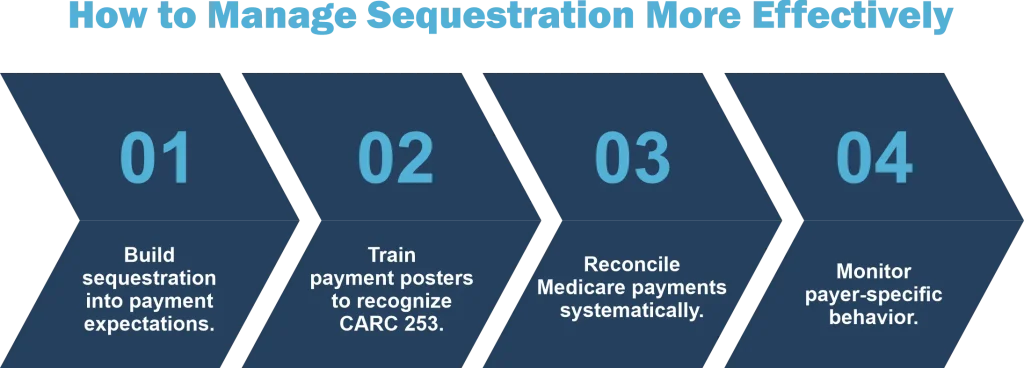
Above all, clean posting keeps A/R reports accurate. Our payment posting services separate sequestration from true underpayments on every ERA.
Common Sequestration Billing Mistakes
- Treating CO-253 as a denial: this leads to pointless resubmissions.
- Applying 2% to billed charges: the cut applies to the Medicare payment, not your charge.
- Billing the patient: similarly, the reduction never becomes patient responsibility.
- Posting only the deposit: skipping the ERA detail makes reconciliation hard.
- Using one rule for every plan: instead, Medicare Advantage follows plan contracts.
How Sequestration Affects Your Revenue Cycle
At first, a 2% cut looks small on one claim. However, it adds up for practices with high Medicare volume. For instance, $100,000 in Medicare payments means about $2,000 in sequestration reductions.
Even so, you cannot recover that amount through appeals or patient billing. Instead, build it into your payment forecasts. In addition, separate it from true revenue leakage, such as contractual allowance adjustments, underpayments, coding reductions, and denials. That way, staff focus their follow-up on money they can actually recover.
Final Takeaway
In short, sequestration in medical billing is a federal 2% reduction in applicable Medicare payments. It is not a denial, and it is not patient responsibility. When you see CO-253, verify the math, post it correctly, and move on to claims that need real follow-up.
Struggling with Medicare payment variances? Dr Biller RCM helps practices reconcile ERAs and recover true underpayments through medical billing services and denial management. Request a free RCM audit to see where your revenue is slipping.
FAQs
What is sequestration in medical billing?
It is a federally required reduction in applicable Medicare payments. Currently, for Medicare FFS, the current rate is 2%, applied after deductible, coinsurance, and secondary payer amounts.
What does CO-253 mean?
CO-253 combines the Contractual Obligation group code with CARC 253, the sequestration reduction in federal payment. It is a payment adjustment, not a true denial.
Can I bill the patient for the sequestration amount?
No. In fact, sequestration reduces only the Medicare payment. The patient’s deductible and coinsurance do not change.
Does sequestration apply to Medicare Advantage?
Yes, at the plan payment level. However, each plan sets its own provider payment terms, so follow the plan contract.